




 For decades, astronomers and planetary scientists have been baffled by the slightly irregular orbits of planets in our solar system. Conventional models predict that planetary orbits should be nearly circular and lie in a flat plane, especially in a system as old and stable as ours. However, observations reveal subtle deviations, particularly among the outer giant planets like Jupiter, Saturn, Uranus, and Neptune. These orbital discrepancies, while small, have persisted as a puzzle that challenges our understanding of planetary dynamics.
The prevailing theories often focused on gravitational interactions among the planets themselves. These interactions could nudge orbits over billions of years, creating the minor irregularities observed today. Yet, even the most advanced simulations and models have struggled to fully replicate the current configuration of the solar system. The cause of these orbital quirks has remained elusive—until now.
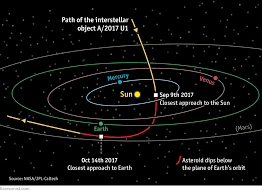
A ground breaking new study introduces a compelling alternative explanation. According to researchers, the anomalies in planetary orbits might not be due to interactions within the solar system. Instead, the culprit could be an interstellar object—a substellar body that wandered into our solar system billions of years ago.
 This theory posits that the object, potentially as massive as Jupiter or even a brown dwarf, passed close to the Sun during the chaotic early days of the solar system. Its gravitational pull would have perturbed the orbits of the planets, particularly the massive outer giants. The study suggests that this flyby event introduced the deviations we see today.
To explore this hypothesis, researchers conducted an ambitious series of 50,000 simulations. They adjusted parameters such as the size, velocity, and trajectory of the interstellar visitor to test how it could influence planetary orbits. These simulations revealed that a wide range of substellar objects could have caused the observed orbital shifts, providing a plausible explanation for the discrepancies.
 While this study offers an intriguing new perspective, it remains in the early stages of scientific scrutiny. Peer review and further research will be essential to validate these findings. Nonetheless, the theory opens exciting new avenues for exploration.
Astronomers could look for signatures of past interstellar encounters in other planetary systems, comparing their architectures with our own. Observations of rogue planets and other interstellar objects, like ‘Oumuamua and Borisov, could also offer valuable insights. Advances in technology, such as next-generation telescopes, may enable us to detect the faint traces of these cosmic visitors and their effects.
